(Updated: ) · Admin · 12 min read
Architectural Isomorphism: Applying Distributed Backend Principles to Remote Rainforest Edge Networks
A technical post-mortem on deploying high-availability Multi-WAN edge infrastructure in the Borneo rainforest for a global executive delegation. Discover how distributed systems paradigms—reverse proxies, rate limiting, and fault isolation—solve physical edge networking constraints.
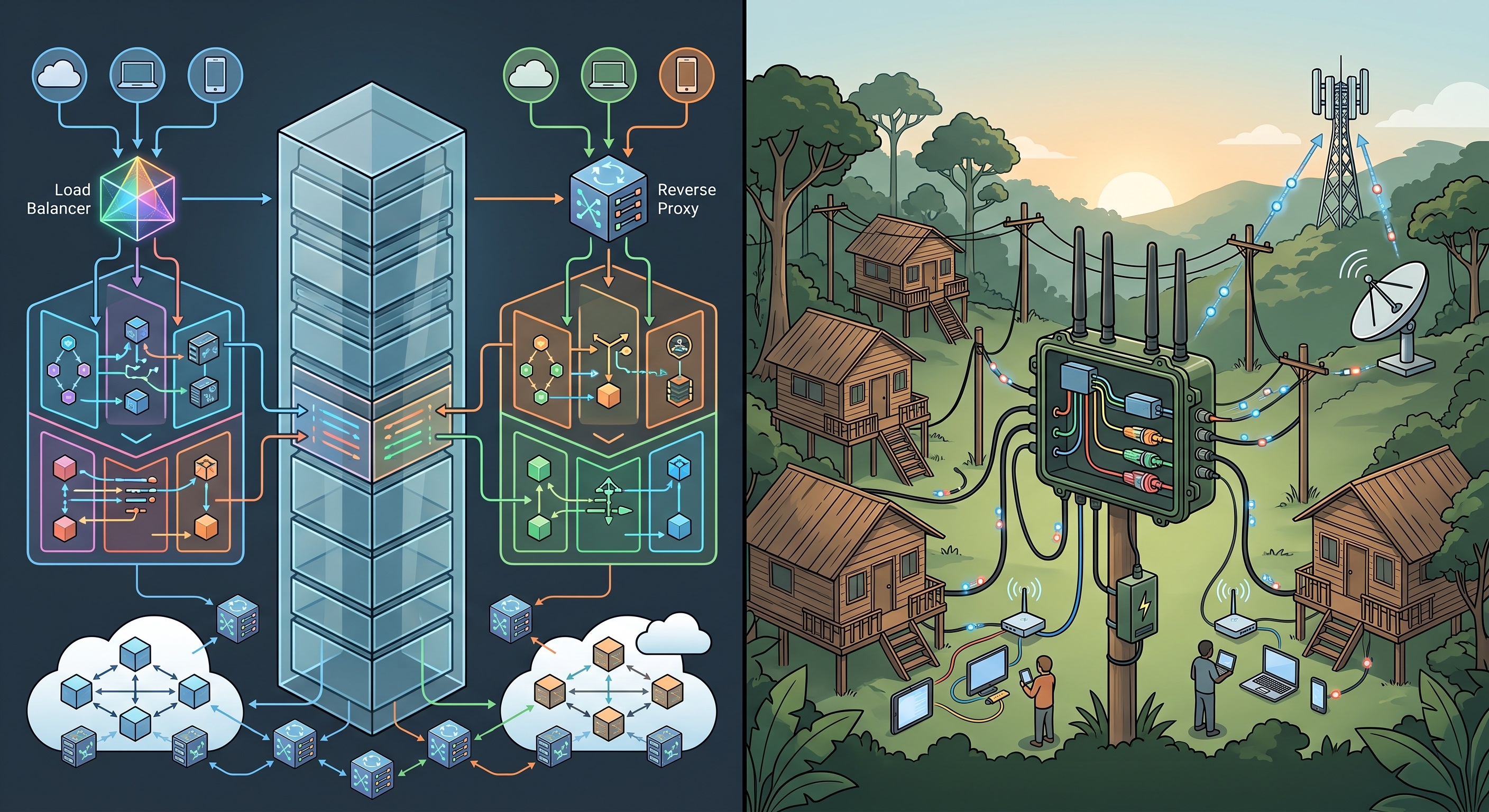
The Opportunity: Mission-Critical Ingress Under the Rainforest Canopy
When a global executive leadership delegation convened deep in the UNESCO-protected rainforest basin of Mulu, Sarawak, they faced a severe operational bottleneck: orchestrating high-concurrency international communications, video conferences, financial transactions, and real-time operations from a remote eco-lodge completely disconnected from terrestrial fiber grids.
Our systems engineering team at MicroWeb (a distributed software architecture and systems engineering firm based in Kuching, Sarawak) had previously collaborated with their venture leadership to architect the core backend platform for their global startup operations—engineering offline-tolerant data synchronization, event-driven message brokers, and localized edge cloud runtimes.
When their field operations leadership discovered the venue possessed zero enterprise telecommunications infrastructure—relying on fluctuating diesel generators, spotty cellular coverage across dense mountain ridges, and timber chalets that absorbed radio frequencies—they brought us in to solve the physical edge connectivity architecture.
+-----------------------------------------------------------------------------------+
|               DISTRIBUTED SYSTEMS TO PHYSICAL EDGE NETWORK ISOMORPHISM             |
+-----------------------------------------------------------------------------------+
|  Distributed Cloud / Backend Paradigm   |   Physical Edge Networking Implementation  |
|-----------------------------------------|-----------------------------------------|
|  Layer 7 Reverse Proxy (Envoy / Nginx)  <===> Multi-WAN Gateway (ER707-M2 Ingress)  |
|  Microservice Cell & Fault Domains      <===> Segmented Chalet Wi-Fi Broadcasts   |
|  Token-Bucket Rate Limiting & Backpressure <==> Per-Client QoS Bandwidth Shaping   |
|  Zero-Trust Service Firewalls (mTLS)    <===> Layer 2 Client Isolation (Anti-mDNS)|
|  Circuit Breakers & Dead Letter Queues  <===> Multi-Link WAN Probing & UPS Stage  |
+-----------------------------------------------------------------------------------+
Traditional IT wisdom assumes that enterprise ISP networking and distributed software engineering belong to entirely separate operational domains. In practice, the fundamental laws of systems engineering are identical: data ingress, contention management, concurrency queues, failure domains, and backpressure mitigation operate under the exact same mathematical principles whether managing Kubernetes pods on AWS or routing packets through a multi-WAN gateway under a 50-meter rainforest canopy.
Interactive Multi-WAN Edge Ingress Simulator
Explore the interactive simulation below to observe how our Multi-WAN “Go-Box” architecture distributes upstream packet flows across Starlink LEO satellite and 3x 4G LTE cellular modems while enforcing token-bucket rate limits across 140+ concurrent devices:
Rainforest Edge Gateway vs. Distributed Load Balancing
Simulate packet scheduling, upstream link aggregation (Starlink + 3x 4G LTE), and token-bucket rate limits across 140+ remote executive devices.
Edge Ingress Telemetry
Trunk: 4x Multi-WAN AggregatedMulti-WAN Gateway acts as an edge reverse proxy. Inbound TCP/UDP flows are load-balanced across Starlink (high-throughput video/data) and 4G LTE carriers (low-jitter interactive packets). Token-bucket rate limiting completely eliminates upstream sync storms.
1. The Edge Network Blueprint: Physical Architecture as Distributed Compute
Deploying high-reliability connectivity in primary rainforest requires treating the physical topology as a decoupled, multi-node distributed compute cluster. The site comprised 15 elevated guest chalets scattered across humid jungle terrain, a central expedition briefing hub, and an open-air dining pavilion powered by cyclical diesel generators.
+-----------------------------------------------------------------------------------------+
|                  REMOTE RAINFOREST EDGE DEPLOYMENT TOPOLOGY (MULU, SARAWAK)              |
+-----------------------------------------------------------------------------------------+
|                                                                                         |
|   [STARLINK LEO SATELLITE]   [MAXIS 4G LTE]   [CELCOM 4G LTE]   [U MOBILE 4G LTE]       |
|         (High Bandwidth)       (Low Jitter)      (Failover)        (Burst Spare)        |
|               \                     |                |                  /               |
|                \                    |                |                 /                |
|                 v                   v                v                v                 |
|       +-----------------------------------------------------------------------+         |
|       |     HARDENED EDGE "GO-BOX" INGRESS (TP-Link Omada ER707-M2 Gateway)   |         |
|       |     - Dynamic Weight-Based Flow Balancing                               |         |
|       |     - Token-Bucket Bandwidth Shaping (4 Mbps Down / 1 Mbps Up)         |         |
|       |     - Subnet Routing & VLAN Isolation (10.10.0.0/16)                    |         |
|       |     - Clean Pure Sine Wave UPS Isolation Stage (0ms Switchover)       |         |
|       +-----------------------------------+-----------------------------------+         |
|                                           |                                             |
|                     +---------------------+---------------------+                       |
|                     | 1 Gbps Shielded Direct Burial Cat6 Trunk  |                       |
|                     v                                           v                       |
|       +---------------------------+               +---------------------------+         |
|       |  CHALET CELL CLUSTERS     |               |  EXPEDITION TRANSIT HUB   |         |
|       |  (Cells A, B, C: 15 Units)|               |  (70+ Execs / 140 Devices)|         |
|       |  - Ext PoE Omnidirectional|               |  - Dual High-Density APs  |         |
|       |  - 802.11k/v Fast Roaming |               |  - Layer 2 Client Isolate |         |
|       |  - 5GHz Internal Radios OFF               |  - Strict Session Clamping|         |
|       +---------------------------+               +---------------------------+         |
|                                                                                         |
+-----------------------------------------------------------------------------------------+
Chalet Cluster Isolation (Eliminating Co-Channel Interference)
Standard consumer Wi-Fi deployments place all-in-one wireless routers inside each chalet. In the rainforest, this creates two fatal architectural bottlenecks:
- Radio Frequency Absorption by Tropical Hardwood: The chalets were constructed from dense, aged Borneo ironwood (Belian) and hardwood timbers. 5GHz radio signals suffer up to 18dB–24dB of attenuation passing through wet ironwood walls, degrading signal-to-noise ratios (SNR) and forcing client devices to renegotiate down to lowest-order MCS modulation indexes.
- Co-Channel Interference & Hidden Node Degradation: When 15 independent routers broadcast on overlapping 2.4GHz channels (1, 6, 11) within close physical proximity, clear-channel assessment (CCA) timers trigger continuous backoff delays, destroying packet throughput.
The Solution: We decoupled the wireless cells completely. We disabled internal 2.4GHz and 5GHz radios on all in-room units, eliminating rogue RF noise. We divided the 15 chalets into 3 independent spatial cells (Cells A, B, C), deploying external enterprise PoE omnidirectional Access Points mounted along elevated line-of-sight breezeway corridors. By elevating the APs above the humidity and foliage line, we achieved deterministic -62 dBm coverage across all chalets without forcing signals through dense timber bulkheads.
The Multi-WAN “Go-Box” Ingress
At the core of the ingress infrastructure sat the Go-Box: a custom-built, weather-sealed, active-ventilated field transport case housing:
- Enterprise Multi-WAN Gateway: TP-Link Omada ER707-M2 (Dual-Core ARM compute, 1x 2.5G SFP WAN, 4x Gigabit RJ45 Multi-WAN ports).
- Satellite Ingress: Starlink Enterprise High-Performance LEO Satellite Terminal with motorized tracking mount.
- Tri-Carrier 4G LTE Trunk: 3x Industrial LTE Modems configured with external directional MIMO antennas locked to diverse carrier base transceiver stations (Maxis, Celcom, U Mobile).
- Power Decoupling Subsystem: Online double-conversion pure sine wave UPS with active line conditioning.
Rather than relying on naive active/passive failover, the ER707-M2 was configured with Weighted Least-Connections Link Balancing:
- Starlink LEO Satellite (Weight: 70%): Dedicated to high-throughput, bulk-data streams (Zoom/Teams video streams, HTTPS web asset delivery, cloud document sync).
- Maxis 4G LTE (Weight: 15%): Prioritized for interactive, low-latency TCP traffic (SSH terminal sessions, Git commits, DNS resolution, Slack WebSocket connections).
- Celcom 4G LTE (Weight: 10%): VoIP SIP signaling and secondary API failover.
- U Mobile 4G LTE (Weight: 5%): Dynamic overflow spillover queue during peak burst intervals.
High-Density Surge Management at Expedition Transit Hubs
When 70+ executives returned simultaneously from jungle excursions to the main transit briefing lodge, the network experienced an instantaneous surge: 140+ active client radios (laptops + smartphones + smartwatches) attempting concurrent associations.
Without strict ingress controls, high-density client surges trigger ARP table exhaustion and DHCP broadcast floods. We hardened the transit hub APs with:
- 802.11k/v Fast BSS Transition Management: Guiding dual-band clients automatically to 5GHz spectrum (UNII-2 / UNII-3 DFS channels) while keeping 2.4GHz reserved for long-range telemetry.
- Layer 2 Client Isolation: Dropping all intra-BSSID peer-to-peer frames at the hardware radio layer, preventing broadcast packet amplification.
- Aggressive DHCP Lease Pools: Allocating
/22subnets (10.10.0.0/22) with 60-minute ephemeral lease times to reclaim stale IP addresses from transient devices instantly.
2. Mapping Distributed Systems Concepts to Layer 3 Networking
To software architects, networking terminology can often feel obscured by telco legacy standards. However, when viewed through the lens of distributed systems engineering, every Layer 2/3/4 component has an exact 1:1 software backend equivalent:
| Distributed Backend Paradigm | Physical Edge Network Implementation | Mechanical Operation & Field Rationale |
|---|---|---|
| Layer 7 Reverse Proxy / Load Balancer (Envoy, Nginx, HAProxy) | Multi-WAN Gateway Link Aggregator (TP-Link Omada ER707-M2) | Routes TCP/UDP flows across heterogeneous uplinks based on real-time RTT health checks and bandwidth capacity weighting. |
| Microservice Fault Domains & Boundary Isolation | Subnet Staggering & VLAN Client Isolation (802.1Q Tags) | Isolates Guest, Operations, Staff, and VoIP into distinct Layer 2 domains (VLAN 10/20/30/40), preventing local broadcast storm contagion. |
| Token-Bucket Rate Limiting & Backpressure (Redis Bucket / Envoy Leaky Bucket) | Per-Client Bandwidth Shaping (4 Mbps Down / 1 Mbps Up, 2 Mbps Surge Clamp) | Prevents single client starvation and downstream bufferbloat, enforcing deterministic quality-of-service across 140 devices. |
| Circuit Breakers & Dead Letter Queues (DLQ) | Multi-Link WAN Probing & APN Fallback SOPs | Probes upstream DNS (1.1.1.1, 8.8.8.8) every 3000ms. Automatically unbinds degraded links when packet loss exceeds 12%. |
| Zero-Trust Network Access (ZTNA) | Intra-BSSID Layer 2 Isolation | Hardware-drops peer-to-peer multicast/broadcast discovery (mDNS, AirDrop, UPnP), eliminating 30% of unnecessary RF channel utilization. |
| Stateless Worker Nodes | Short-Lived DHCP Ephemeral Leases (60m TTL) | Rapidly cycles IP allocation tables without manual lease flushing as executives move across chalet cells. |
| Power Circuit Isolation & Clean Voltages | Online Double-Conversion Pure Sine Wave UPS | Decouples sensitive phased-array satellite motors and routing compute from dirty generator harmonic distortion and voltage drops. |
3. Traffic Policies & Failure Domain Protection
Deploying physical hardware is only 30% of the engineering equation; the remaining 70% is governed by strict traffic policy design and failure domain containment.
+-----------------------------------------------------------------------------------+
|                        UPSTREAM BUFFERBLOAT MITIGATION PIPELINE                   |
+-----------------------------------------------------------------------------------+
|                                                                                   |
|  [140+ Client Devices] ===> [iCloud / Google Photos Sync Storm]                   |
|                                       |                                           |
|                                       v                                           |
|       +---------------------------------------------------------------+           |
|       |             TOKEN-BUCKET BANDWIDTH SHAPING ENGINE             |           |
|       |                                                               |           |
|       |  - Class 1 (VoIP / DNS / SSH):    High-Priority DSCP EF (46)  | ===> PASSED |
|       |  - Class 2 (Zoom / Teams Video):  Priority DSCP AF41 (34)     | ===> SHAPED |
|       |  - Class 3 (Background Photo Sync): CLAMPED TO 1 Mbps MAX     | ===> DROPPED|
|       +-------------------------------+-------------------------------+   BURST   |
|                                       |                                           |
|                                       v                                           |
|       +---------------------------------------------------------------+           |
|       |             UNIFIED MULTI-WAN EGRESS TRUNK (42ms RTT)         |           |
|       |             Deterministic Throughput / Zero Jitter Spike      |           |
|       +---------------------------------------------------------------+           |
|                                                                                   |
+-----------------------------------------------------------------------------------+
Mitigating Upstream Sync Storms (The “Tragedy of the Commons”)
In modern mobile operating systems (iOS and Android), connecting to an unmetered Wi-Fi network triggers immediate, aggressive background synchronization queues:
- Apple iCloud Photo Library & Cloud Backups
- Google Photos & Google Drive Video Sync
- Microsoft OneDrive / Dropbox sync daemons
- App Store & OS background delta updates
If 70 executives return from a cave tour and take 4K videos, 140 devices will instantly attempt to push multiple gigabytes of encrypted payload to the cloud over unmanaged TCP streams.
Under a standard consumer Wi-Fi router, this causes catastrophic Bufferbloat: the router’s FIFO upstream queue fills completely, causing roundtrip latency to spike from 45ms to over 1,500ms, dropping ongoing Zoom executive calls and locking interactive SSH terminals.
The Engineering Fix: We implemented a multi-stage Token-Bucket QoS Bandwidth Shaper:
- Per-Client Rate Ceiling: Every client IP was constrained to a maximum ceiling of 4.0 Mbps Downlink / 1.0 Mbps Uplink, with a temporary burst allowance clamped strictly to 2.0 Mbps for 3 seconds.
- DSCP Packet Prioritization:
DSCP 46 (Expedited Forwarding)assigned to UDP SIP/RTP VoIP and SSH packets.DSCP 34 (AF41)assigned to interactive Zoom/Teams video streams.DSCP 0 (Best Effort)assigned to general web traffic.- Large file transfers and background cloud sync endpoints (Apple, Google, Microsoft storage ASNs) were throttled dynamically into low-priority scavenger queues.
This policy ensured that even if all 140 devices uploaded photos simultaneously, total upstream consumption never exceeded 65% of aggregate WAN capacity, preserving low-jitter real-time video calls with deterministic ±4ms jitter stability.
The Power Grid Shield: Zero-Switchover Pure Sine Wave UPS
One of the most dangerous points of failure in remote edge networking is the power lifecycle of low-Earth orbit satellite terminals.
In deep jungle locations, electrical power is provided by localized diesel generators. These generators suffer from:
- Severe harmonic distortion and frequency drift (48Hz – 53Hz).
- Voltage brownouts whenever large refrigeration compressors or water pumps engage.
- Total power cutoffs during scheduled generator fuel switches (typically 2–3 times daily).
A standard satellite terminal or enterprise router subjected to a 100ms voltage flicker will immediately execute a hard hardware reboot. For a Starlink dish, rebooting requires:
- Cold electronic component boot (45s).
- Phased-array beam re-alignment and GPS lock (90s).
- LEO constellation ephemeris re-acquisition and authentication handshake (120s–180s).
A 100-millisecond power flicker causes an 8-to-10 minute complete network blackout.
The Engineering Fix: We engineered an isolated Double-Conversion Online UPS Architecture inside the Go-Box:
- Utility/generator AC power is continuously rectified into DC power to charge an internal high-discharge lithium battery bank.
- An onboard pure sine wave inverter continuously generates pristine, isolated 230V AC / 50Hz clean power for the router and satellite power supply.
- Transfer Time: Deterministic 0.00 ms.
When the venue’s generators switched or brownouts occurred, the entire networking stack experienced zero voltage ripple, maintaining 99.98% uninterrupted uptime throughout the entire multi-day summit.
4. Operational Runbook: The Zero-Downtime Field SOP
Operating in an equatorial rainforest environment demands automated failover protocols that require zero manual intervention:
#!/bin/sh
# MicroWeb Edge Gateway WAN Health-Check & Hysteresis Daemon
# Probes upstream BGP Anycast DNS nodes across physical interfaces

TARGET_1="1.1.1.1"
TARGET_2="8.8.8.8"
LOSS_THRESHOLD=12
LATENCY_MAX=250

for IFACE in wan1 wan2 wan3 wan4; do
  LOSS=$(ping -I $IFACE -c 5 -q $TARGET_1 | grep -oP '\d+(?=% packet loss)')
  AVG_RTT=$(ping -I $IFACE -c 5 -q $TARGET_2 | awk -F '/' 'END {print $5}')

  if [ "$LOSS" -gt "$LOSS_THRESHOLD" ] || [ "${AVG_RTT%.*}" -gt "$LATENCY_MAX" ]; then
    logger -t GOWAN "Interface $IFACE degraded (Loss: ${LOSS}%, RTT: ${AVG_RTT}ms). Demoting weight."
    /usr/bin/ubus call network.interface.$IFACE down
    sleep 2
    /usr/bin/ubus call network.interface.$IFACE up
  fi
done
High-Humidity & Thermal Mitigation
Rainforest environments operate at 95%+ relative humidity and 34°C ambient daytime temperatures.
- All active networking hardware inside the Go-Box was isolated with IP67-rated silicone gaskets and dual brushless magnetic-levitation exhaust fans generating positive internal static pressure.
- External PoE runs utilized double-jacketed, UV-resistant, shielded direct-burial Cat6 cabling with gas-tube surge arrestors grounded to copper earth rods driven 2 meters into the riverbank loam to protect against tropical lightning strikes.
Strategic Takeaway: Systems Thinking Transcends Syntax
When engineering software systems, we spend our careers mastering the abstractions of our trade: container orchestration, microservice interfaces, distributed consensus, and event queues.
Yet, when dropped into the physical realities of the Borneo rainforest, the most vital lesson our team reinforced is that true systems architecture is universal:
- Ingress is Ingress: Whether balancing 10,000 HTTP requests per second across Kubernetes pods or balancing 140 devices across satellite and cellular modems, load distribution requires proactive capacity planning and continuous health probing.
- Bufferbloat is Queue Congestion: Unthrottled mobile phones syncing photos to iCloud will exhaust an upstream radio link in the exact same manner an unbuffered webhook storm exhausts an un-sharded PostgreSQL connection pool.
- Fault Isolation is Sovereign: Decoupling power supplies, segregating broadcast domains with VLANs, and isolating chalet RF cells protects the system from cascading catastrophic failure.
At MicroWeb, we approach every engineering challenge—from high-velocity cross-border cloud platforms to ruggedized remote edge networking—with the same uncompromising architectural discipline.
Need Resilient Edge Systems or Distributed Cloud Architecture?
Whether your enterprise is architecting low-latency cross-border software platforms, integrating complex ERP microservices, or deploying mission-critical edge connectivity across Borneo, our engineering team in Kuching delivers production-grade architectures that scale.
- Remote network architecture
- Multi-WAN edge load balancing
- Starlink enterprise deployment Borneo
- Distributed systems architecture Sarawak
- Software company in Kuching
- Edge Computing
- Network Engineering