(Updated: ) · Admin · 4 min read
Decoupling Tech-Shock: Building Secure WhatsApp-to-ERP AI Integration Pipelines
An architectural brief on embedding autonomous AI agents, automated Google Review engines, and computer-vision photo parsing modules natively into legacy corporate software backends.
The User Adoption Barrier: Forcing Apps Destroys Conversion Volume
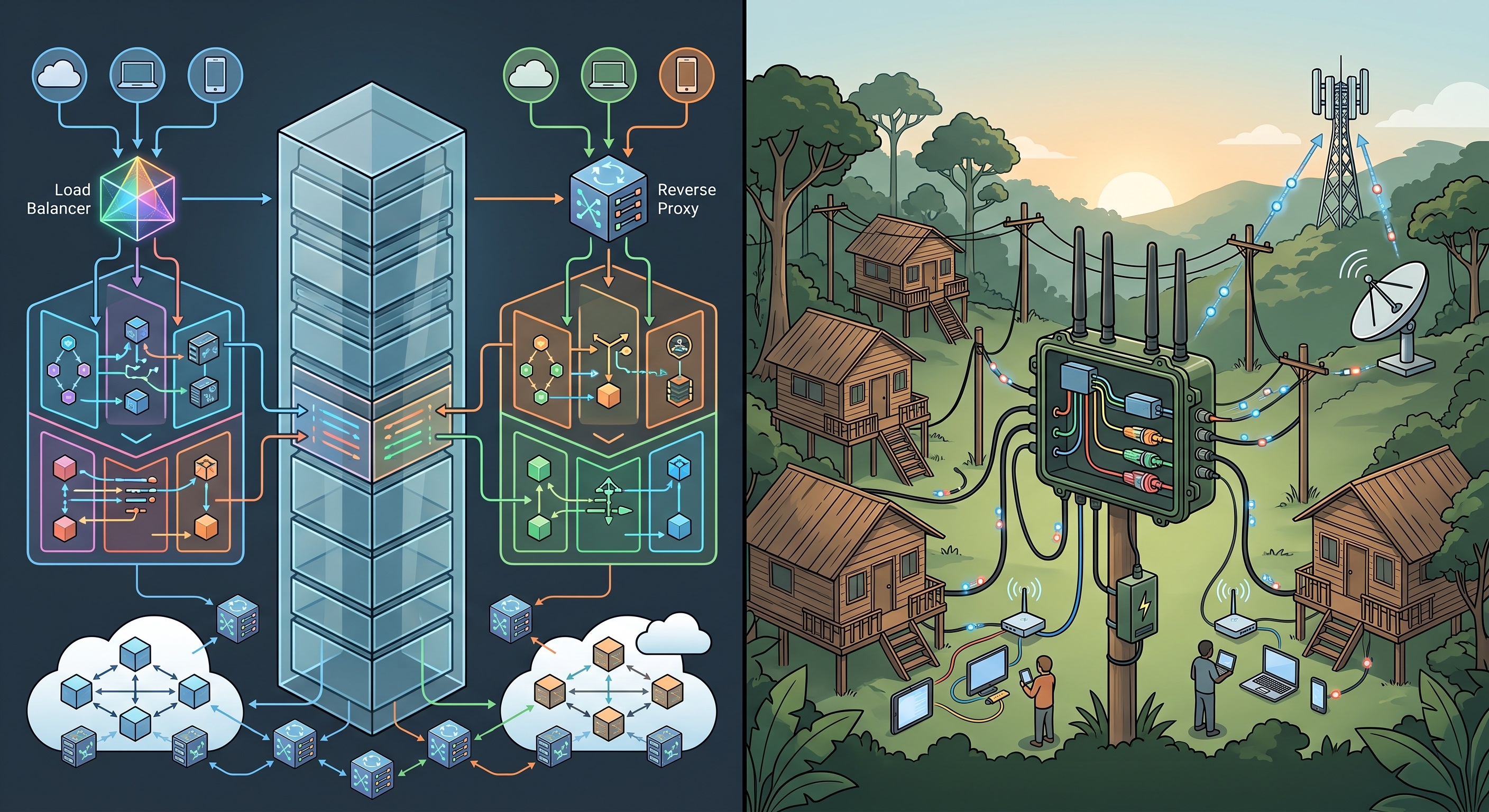
When regional enterprises scale field operations or customer ordering paths, they routinely fall into the trap of premature optimization: forcing non-technical retail clients, field logistics teams, or B2B distributors to download standalone mobile apps or navigate complex web forms. This structural friction breaks traditional user habits, causes instant drop-offs, and triggers massive technology adoption failures.
To generate a localized liquidity of trust, systems architects must eliminate “tech-shock” entirely. The resolution lies in a simple guiding principle: Meet your users exactly where they live—inside WhatsApp.
By wrapping an invisible agentic shield around your internal infrastructure, users can execute complex database queries, book site appointments, upload handwritten invoices, or trigger Google Business Profile feedback loops using natural chat parameters 24/7.
This technical brief outlines the core architecture of our modular WhatsApp-to-Software Integration Engine, built to decouple legacy backend technical debt while maximizing data ingestion velocity across Malaysia.
Interactive API Processing & Response Velocity Simulator
Adjust the transaction volumetric sliders below to observe how our decoupled middleware handles high-velocity webhook loads, tracking projected endpoint latencies and system node cluster thresholds in real time:
The System Architecture Blueprint
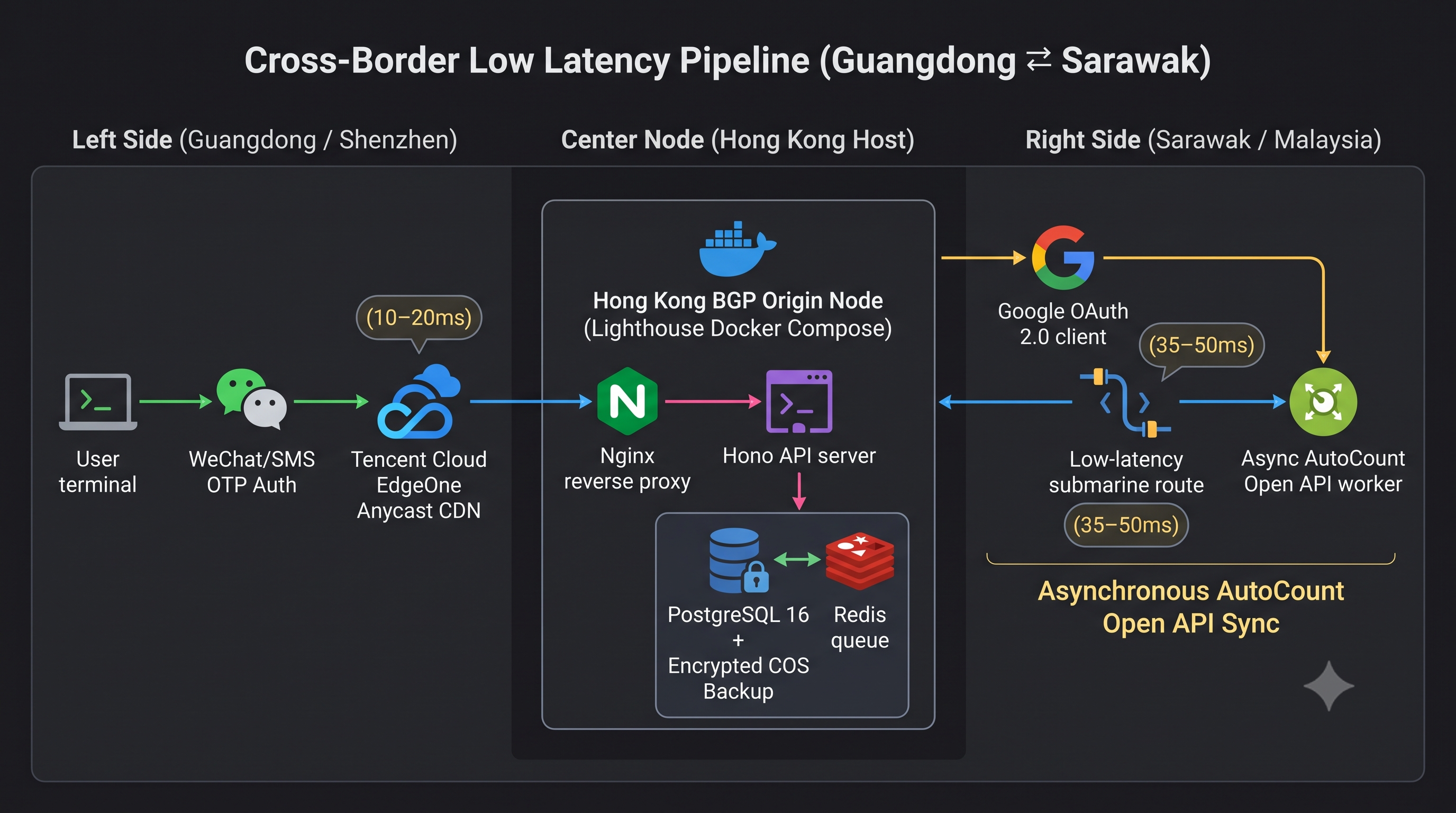
Our deployment bypasses brittle public wrappers by using a fully decoupled, enterprise-grade middleware pipeline designed for absolute data sovereignty.
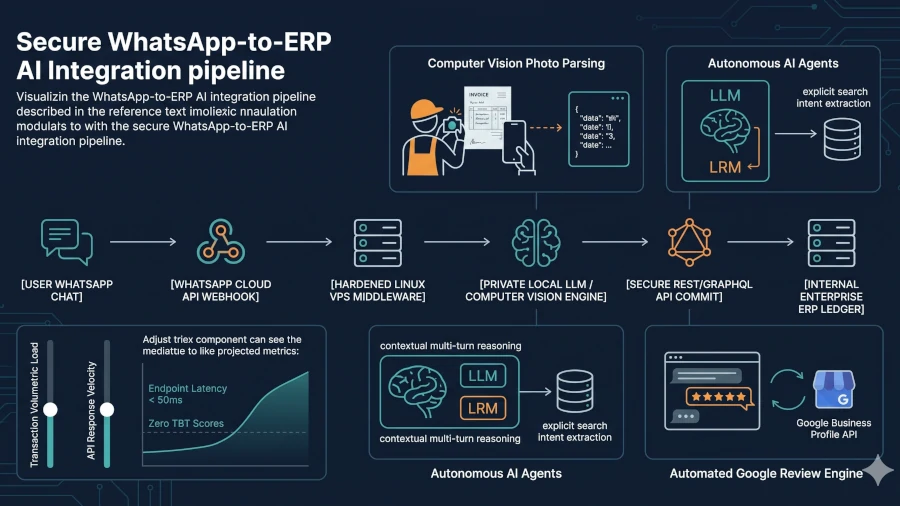
[User WhatsApp Chat] ──> [WhatsApp Cloud API Webhook] ──> [Hardened Linux VPS Middleware] ──> [Private Local LLM / Computer Vision Engine] ──> [Secure REST/GraphQL API Commit] ──> [Internal Enterprise ERP Ledger]
1. Inbound Ingestion Layer (WhatsApp Cloud API Webhooks)
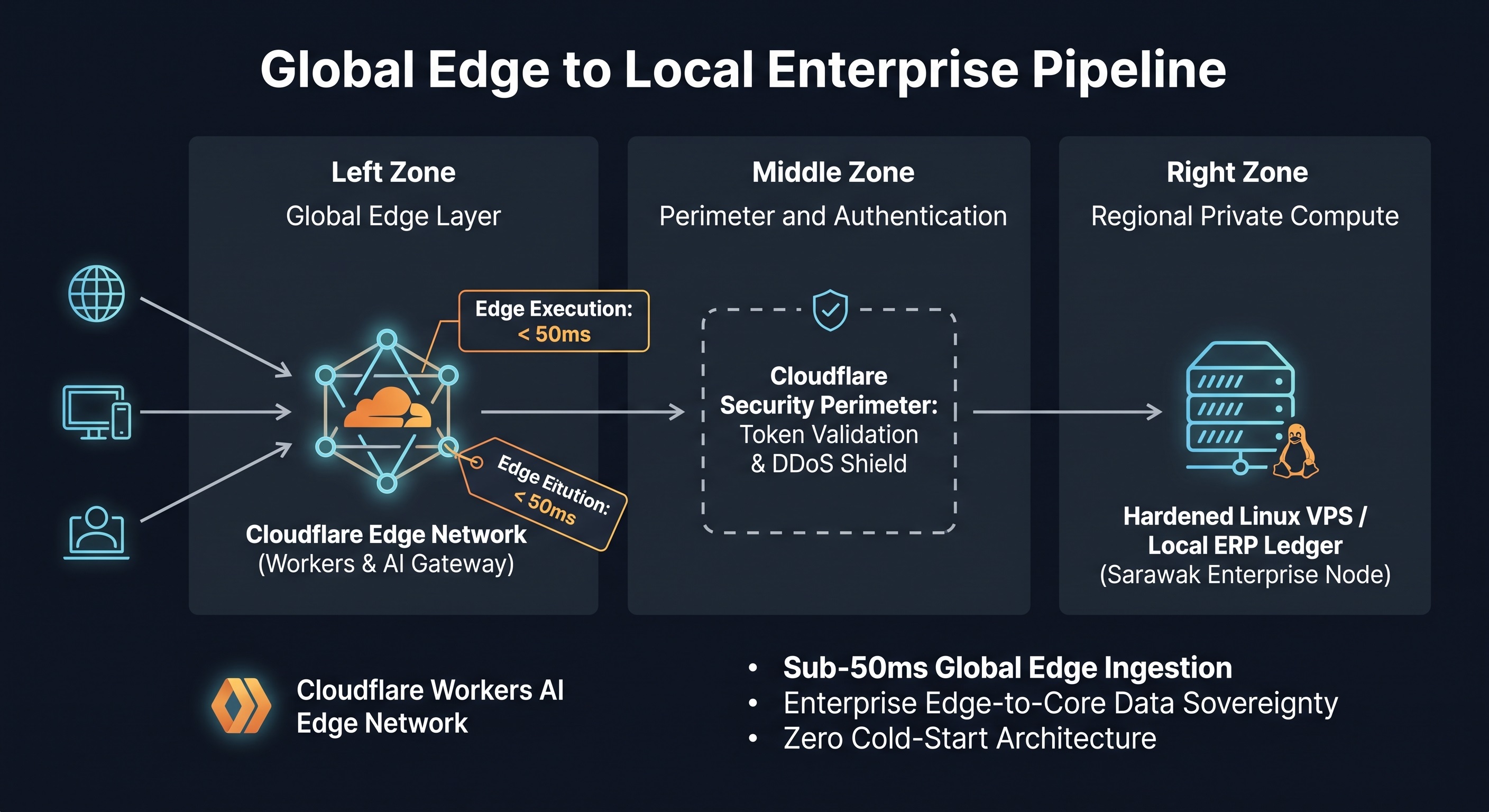
Incoming messages, binary audio notes, and multi-media images hit our edge routing gateway via secure WhatsApp Cloud API webhook nodes. This entry point is hidden from direct public access behind an enterprise Cloudflare perimeter that intercepts, filters, and validates packet tokens in less than 50ms.
2. The Conversion Execution Engine (Computer Vision & Token Parsing)
- Snap-Photo-to-Backend Parsing: When a field worker snaps a photo of a warehouse manifest or handwritten invoice, the binary asset is routed to a containerized computer-vision pipeline running on a hardened Linux VPS node. The server extracts table matrices, corrects perspective layout warps, and transforms the raw visual data into clean, structured JSON payloads.
- Contextual Multi-Turn Reasoning: Instead of using primitive keyword matching rules that break when users misspell items, we deploy fine-tuned open-source Large Language Models (LLMs) and Large Reasoning Models (LRMs) on local compute layers to extract explicit search intents contextually.
3. The Automation Commit Layer (WhatsApp-to-ERP API Middlewares)
Once the incoming parameters are programmatically qualified and verified against internal validation metrics, our non-blocking asynchronous gateways push the data payload straight to your internal accounting ledger, CRM, or custom software databases via hardened REST or GraphQL abstraction hooks.
4. Local Trust Loops (Automated Google Review Feedback Hooks)
Satisfied enterprise clients rarely navigate manual external review links. To accelerate your local search optimization (SEO) authority, the engine triggers post-transaction automated feedback loops. The pipeline screens customer sentiment flags directly inside the chat channel, programmatically routing five-star interactions straight to your Google Business Profile API while flagging neutral responses internally for rapid service recovery.
Architectural Parameters: Serverless vs. Bare-Metal Linux VPS
Depending on your data compliance framework and specific transaction velocity profiles, the integration engine partitions into two target hosting layouts:
| Architecture Metric | Serverless Firebase Micro-Pipelines | Dedicated Hardened Linux VPS Nodes |
|---|---|---|
| Operational Scalability | Dynamic Horizontal Autoscaling | Fixed Compute Node Resource Allocation |
| Maintenance Profile | Zero-Management Infrastructure | OS-Layer Kernel Maintenance and Custom Hardening |
| Per-Token API Fees | Variable Cloud Cost Structures | 0% Cost Overhead (Self-Hosted Private LLM) |
| Data Isolation Security | Multi-Tenant Shared Environment | Complete Isolation (Sovereign Local Residency) |
Strategic Implementation Rules: Velocity Over Elegance
Building a perfect backend for an unvalidated market assumption is the highest technical cost an organization can incur. Our deployment lifecycle prioritizes optimizing for time-to-failure over abstract over-engineering.
By building our messaging middleware with completely modular parameters, we can launch a “Wizard of Oz” prototype layout in less than 48 hours—using manual internal triggers behind the frontend chat layer to validate actual consumer response metrics before committing full serverless compute scale.
If your enterprise operations are leaking transaction volume to slow manual administrative key-ins, cold customer follow-up windows, or rigid software portals, your infrastructure is underperforming. Connect with our engineering architect team to secure a technical data mapping audit.
- Analyze Custom Software Specs: Explore our backend compilation capabilities at /software/.
- Optimize Your System Connectivity: Review our API integration profiles over at /integration/.
- Software Company in Kuching
- WhatsApp Automation
- Enterprise System Integration
- AI Workflows