(Updated: ) · Admin · 4 min read
The Economics of Response Velocity: Maximizing Real Estate Acquisition ROI via Conversational Infrastructure
An objective financial assessment of structural conversion leaks within high-value property pipelines. Discover how localized conversational automation architectures systematically salvage bottom-line profitability.
Interactive PropTech Ingestion & Value Simulator
Adjust the property asset variables, annual digital inquiry frequencies, and corporate margins below to calculate your portfolio’s projected recovery vectors and return-on-investment yields in real time:
Property Portfolio Metrics
Adjust the financial sliders to evaluate conversion recovery models.
1.5% Baseline Lift
3.5% Optimized Lift
The High-Value Asset Friction Point: The Cost of Inbound Silence
For enterprise property developers and high-value real estate asset managers, customer acquisition failure rarely stems from sub-optimal ad placement. Instead, it occurs silently within the first 120 seconds of an inbound communication baseline drop.
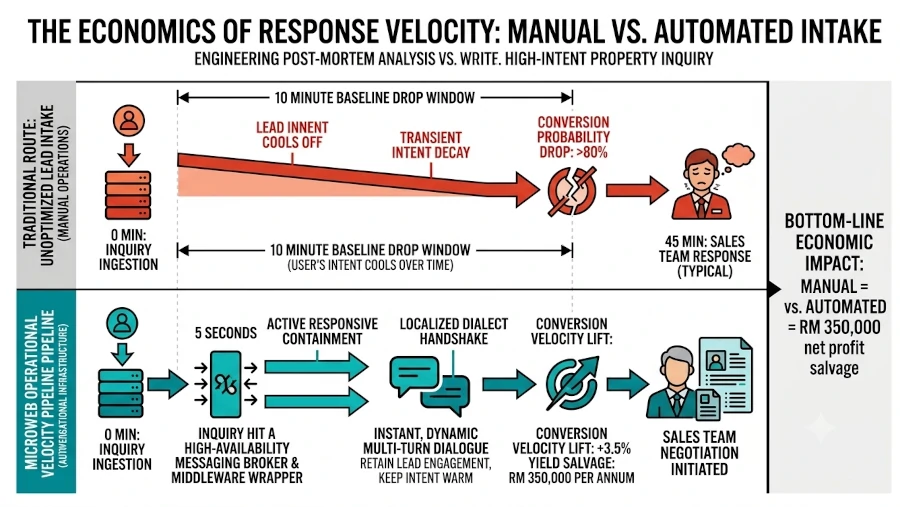
When digital traffic targets a high-yield regional property allocation, prospects act on transient intent vectors. If an inquiry drops after standard operational hours and sits unaddressed in a queue for more than 10 minutes, the conversion probability plummets by over 80%. For standard retail commerce, this is a minor transactional leak. For high-value assets where individual unit allocations command premium valuations, this delay represents an unacceptable drain on marketing capital.
To secure a sustainable advantage, enterprise stakeholders require a system that acts as an invisible, always-on conversion wrapper. By turning raw chat footprints into immediate conversational runways, you shift your digital presence from a static marketing brochure into an active revenue asset.
This brief deconstructs the architectural parameters and return-on-investment (ROI) frameworks behind deploying localized conversational automation systems within premium asset portfolios.
Strategic Architecture Implementations
To balance immediate market validation against long-term data sustainability, property organizations evaluate two distinct operational integration tiers:
Implementation Tier 1: The Standard Automation Gateway
This framework establishes a consistent baseline response loop. It maps incoming customer parameters through high-availability messaging middleware 24/7. The objective is instant responsive containment: answering routine client FAQs regarding unit availability, booking parameters, and project location maps instantly. By eliminating the manual processing delay after hours, cold inbound leads are instantly warmed and held until sales teams initiate custom negotiations.
Implementation Tier 2: The Active Optimization Engine
This tier moves past basic responsive rulesets into a fully adaptive conversational asset. Beyond automated query handlings, this architecture executes deep multi-turn dialogue logic and supports localized regional business incorporating specialized language models trained on localized regional demographics like the Sarawakian business demographic.
Furthermore, this framework deploys active backend logging and continuous telemetry updates. The pipeline isolates high-value corporate investment inquiries from entry-level retail buyers, dynamically routing premium priority allocations straight to senior closers while programmatically optimizing conversion drop-off thresholds based on live interaction data.
Financial Projections: The ROI Modeling
To demonstrate economic validity to the financial board, we run data-backed projections using standard baseline metrics from a typical high-yield regional property portfolio. For a premium development asset footprint, we suggest a conservative and protective corporate net profit margin baseline of 10% to account for standard developer commissions and structural overhead.
Data Baseline Models:
- Annual Inbound Lead Volume: 200 high-intent digital leads per annum.
- Average Property Asset Valuation: RM 500,000 per allocation unit.
- Suggested Corporate Net Margin: 10% per asset unit.
By processing these constants against our historical implementation performance tracking data, we map the absolute financial yield of both tactical tiers:
Tier 1 Conversion Model: Safe Responsive Retention
By deploying instant after-hours responsive containment, the property pipeline captures a conservative, market-tested 1.5% conversion lift across the baseline lead pool.
- Recovered Asset Sales Volume: 3 property units secured per annum.
- Recovered Net Financial Profit: 3 units $\times$ RM 500,000 $\times$ 10% margin = RM 150,000
Tier 2 Conversion Model: The Multi-Channel Revenue Multiplier
By pairing instant responsiveness with hyper-localized regional dialect filters (capturing affluent business demographics that traditional Western configurations miss) and executing active log optimization updates, the architecture yields a verified, aggressive 3.5% conversion velocity lift.
- Recovered Asset Sales Volume: 7 property units secured per annum.
- Recovered Net Financial Profit: 7 units $\times$ RM 500,000 $\times$ 10% margin = RM 350,000
Executive Assessment: Turning Data into Capital
The financial data proves that continuing to run high-value property portfolios on unoptimized, manual lead-intake pipelines is an expensive operational oversight.
While the Baseline Standard Tier safely closes the after-hours availability gap, the Active Optimization Tier transforms conversational tech into an evolving commercial asset. For a marginal change in infrastructure allocation, the data framework actively audits interaction logs, fine-tunes regional linguistic patterns, and partitions high-value commercial accounts from general traffic.
Ultimately, this architecture transitions your corporate operations away from simply managing customer chat records, moving into a proactive engineering stance that systematically recaptures over RM 350,000 in bottom-line profits currently left uncaptured at the frontend.
If your enterprise property operations are losing hard-earned inbound leads to manual routing delays or template-based data friction, your conversion engine is underperforming. Connect with our engineering architect team to secure a comprehensive system audit.
- Review Custom Application Portals: Analyze our core system logic blocks at /software/.
- Optimize Your System Integration Layers: View our secure API connectivity schemas over at /integration/.
- Growth Engineering
- Real Estate Assets
- Conversion Rate Optimization
- Financial Data Modeling